If you’re considering a hair transplant abroad, Egypt and Turkey may both be worth researching. Both destinations have clinics offering hair restoration procedures, including Follicular Unit Extraction (FUE), but choosing where to have surgery involves more than comparing advertised prices.
You need to consider the surgeon who will perform your procedure, the clinic’s standards, your suitability for surgery, the expected result and how your care will be managed after you return home.
A hair transplant in Egypt may be worth considering if you’re looking for treatment in Cairo, access to a specialist consultation and help coordinating an international treatment journey. Turkey is another established destination for hair restoration. Neither country is automatically the better choice: the individual clinic, surgeon and treatment plan matter most.
Through Pyramedicine, international patients can enquire about hair transplant options in Egypt and receive guidance on treatment arrangements.
In this guide, we’ll compare Egypt and Turkey, explain FUE and FUT, explore the factors that affect cost and show you how to assess a hair transplant clinic before making a decision.
Is Egypt or Turkey better for a hair transplant?
There is no universal winner. The most suitable destination depends on the quality of the individual provider, your medical needs, your budget and your preferences for travel and follow-up.
| Factor | Hair transplant in Egypt | Hair transplant in Turkey |
|---|---|---|
| Treatment options | Clinics offer hair restoration procedures, including FUE | Clinics offer hair restoration procedures, including FUE |
| Cost | Depends on the clinic, graft requirements and package | Depends on the clinic, graft requirements and package |
| Surgeon selection | Verify the named surgeon’s qualifications and role | Verify the named surgeon’s qualifications and role |
| Travel | May suit patients who prefer travelling to Cairo or have connections to Egypt | May suit patients who prefer travelling to Istanbul or other Turkish cities |
| International support | Confirm consultation, accommodation and transfer arrangements | Confirm consultation, accommodation and transfer arrangements |
| Aftercare | Establish a clear follow-up plan before travelling | Establish a clear follow-up plan before travelling |
The important point is that excellent and poor providers can exist in either country. A destination’s popularity or the number of procedures performed there does not establish the quality of an individual clinic.
Rather than choosing a country first and a clinic second, compare the actual treatment plans available to you.
How much does a hair transplant cost in Egypt?
The cost of a hair transplant in Egypt depends on several factors, including the extent of hair loss, the number of grafts required, the technique, the surgeon’s fees and the services included in the package.
The NHS hair transplant guide gives a broad UK private price range of £1,000–£30,000, depending on the procedure and clinic. This illustrates how widely costs can vary, even within one country.
For Egypt, the most reliable way to establish the cost of your treatment is to request a personalised quotation following a clinical assessment.
What affects hair transplant prices?
1. Number of grafts
The number of follicular units required depends on the size of the area being treated, donor hair availability, hair characteristics and the desired density.
A higher graft count does not automatically mean a better result. Overharvesting the donor area can cause permanent thinning and limit future treatment options.
2. FUE or FUT technique
FUE involves extracting individual follicular units from the donor area. FUT involves removing a strip of scalp from which follicular units are prepared. The appropriate technique depends on the patient’s anatomy, goals and the surgeon’s assessment.
3. Surgeon involvement
Ask who will perform the medical assessment, design the hairline, extract the grafts, create recipient sites and oversee placement. These responsibilities should be clearly explained before booking.
4. Clinic and anaesthesia fees
The total may include the surgical facility, local anaesthesia, clinical staff, medication and post-operative supplies.
5. Travel and accommodation
International patients should include flights, accommodation, transfers, meals where relevant, time away from work and any additional nights needed for follow-up.
6. Aftercare
Clarify which follow-up appointments are included, how the clinic handles complications and whether additional treatment would incur extra charges.
What should a hair transplant package include?
Before comparing quotations, ask each clinic for a written breakdown covering:
- The planned graft range and the basis for the estimate.
- The named surgeon and their responsibilities.
- The FUE or FUT technique being proposed.
- The surgical facility and anaesthesia.
- Pre-operative assessment and required investigations.
- Medication and post-operative supplies.
- The initial follow-up schedule.
- Accommodation and transfers, if advertised.
- Complication management and additional costs.
- Remote follow-up arrangements after returning home.
Do not select a clinic solely because it advertises the lowest price or the highest graft count.
FUE hair transplant in Egypt: How does it work?
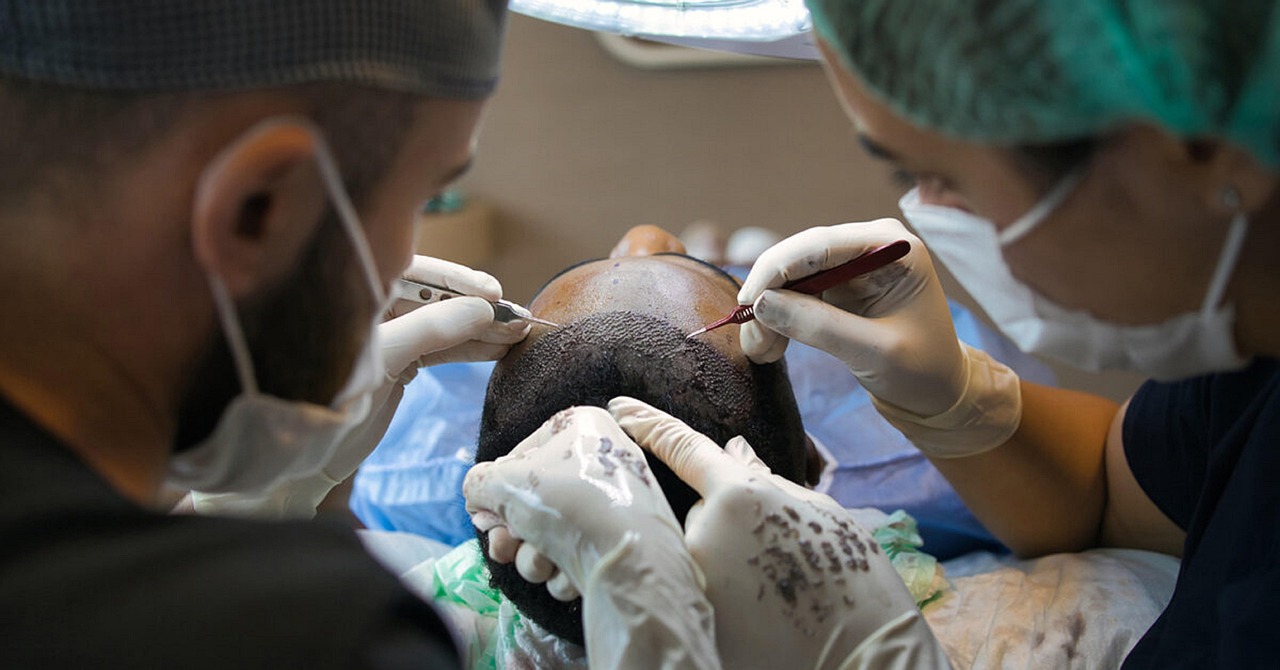
Follicular Unit Extraction, or FUE, is a hair restoration technique in which individual follicular units are removed from a donor area, usually at the back and sides of the scalp, and transplanted into areas affected by hair loss.
FUE is widely used because it avoids the linear donor scar associated with conventional FUT surgery. However, FUE is not scarless: it leaves small scars at the extraction sites, and these can become more visible if the donor area is overharvested or the hair is cut very short.
The main stages of FUE
1. Consultation and hair-loss assessment
The clinician reviews your hair-loss pattern, medical history, family history, scalp condition and treatment goals. The assessment should establish whether the hair loss is stable and whether surgery is appropriate.
2. Donor-area evaluation
The donor area is assessed for density, hair calibre and the number of follicular units that can reasonably be harvested without creating visible thinning.
3. Hairline design
The proposed hairline should take account of your age, facial proportions, existing hair and the likelihood of future hair loss. An excessively low or dense hairline may use donor hair that is needed later.
4. Follicular extraction
Individual follicular units are extracted using small punches under local anaesthesia. The procedure must be planned carefully to avoid unnecessary damage to the donor area.
5. Recipient-site creation and placement
The recipient sites are prepared according to the surgical plan, with attention to hair direction, angle and distribution. Grafts are then placed into the recipient area.
6. Recovery and follow-up
The clinic provides instructions on washing, graft protection, medication and activity restrictions. Follow-up allows the team to assess healing and address concerns.
The exact process and division of responsibilities between the surgeon and clinical team should be explained before surgery.
FUE vs FUT: Which hair transplant technique is better?
Neither technique is automatically better for every patient.
| Feature | FUE | FUT |
|---|---|---|
| Extraction method | Individual follicular units are removed | A strip of scalp is removed and divided into follicular units |
| Donor-area scarring | Multiple small scars | A linear scar |
| Hair length | Often preferred by patients who want to wear shorter hair, although scars remain possible | The linear scar may be more noticeable with very short hair |
| Donor-area considerations | Excessive extraction can cause visible thinning | The procedure depends on suitable scalp laxity and leaves a linear scar |
| Suitability | Depends on donor characteristics, goals and clinical assessment | Depends on donor characteristics, goals and clinical assessment |
Your surgeon should explain why the proposed technique is appropriate for your circumstances. Marketing labels alone are not a reliable guide to surgical quality.
Who is a suitable candidate for a hair transplant?
A hair transplant is not the right treatment for every type of hair loss.
The NHS notes that transplantation is generally used for permanent hair loss, such as hereditary pattern baldness, and is not usually suitable for conditions such as alopecia areata.
A specialist assessment should consider:
- Your age and pattern of hair loss.
- Whether hair loss is stable or continuing to progress.
- The density and quality of the donor area.
- Your medical history and scalp health.
- The cause of hair loss.
- Previous medical or surgical treatments.
- Your expectations regarding density and coverage.
- Whether you may need further treatment in the future.
Some patients benefit from medical treatment before surgery, while others may need investigations to identify the cause of hair loss.
A transplant redistributes existing hair follicles; it does not create an unlimited supply of new follicles. Planning should therefore consider both the desired result today and how your hair may change over the coming years.
How many grafts will you need?
There is no single graft number suitable for everyone.
A patient seeking to restore a receding hairline may require a different plan from someone with extensive thinning across the frontal scalp and crown. Hair thickness, curl, colour contrast and donor density also affect how much coverage a given number of grafts can provide.
Your clinician should assess the donor area and explain:
- The estimated number of follicular units required.
- The areas that will be prioritised.
- The expected density and limitations.
- How much donor hair should be preserved for the future.
- Whether more than one procedure might be considered.
Be cautious of clinics that promise very high graft counts without assessing your donor supply. Extracting too many follicles can compromise the donor area and reduce options for future treatment.
Hair transplant results: When will you see new hair growth?
Hair transplantation requires patience. The transplanted follicles go through a healing and growth cycle, and the final appearance develops over months rather than days.
The NHS provides the following general timeline:
| Stage | Typical experience |
|---|---|
| First few days | Swelling, tenderness and scabbing may occur |
| First 1–2 weeks | The grafts need careful protection while the scalp heals |
| Following weeks | Transplanted hair commonly sheds temporarily |
| Around 4 months | New growth often begins to become visible |
| Around 10–18 months | The overall result may become apparent |
Individual timelines vary, and the crown can take longer to show its final appearance than the frontal hairline.
A clinic should explain what you can reasonably expect, how results will be assessed and what happens if growth is less than anticipated.
What makes a hair transplant look natural?
Natural-looking results depend on more than the number of grafts.
Important factors include:
- A hairline suited to your age and facial proportions.
- Appropriate graft distribution and density.
- Correct orientation and angle of implanted hairs.
- Careful use of donor hair.
- Consideration of future hair loss.
- A treatment plan that respects the limitations of your donor supply.
No clinic can guarantee a particular density or outcome. Before-and-after photographs can be useful, but they should be genuine, representative and assessed alongside a discussion of your own suitability.
Is a hair transplant permanent?
Transplanted follicles can provide long-lasting hair growth, but the overall appearance may change over time.
Hair loss can continue in non-transplanted areas, potentially creating a contrast between transplanted and native hair. This is why a good plan considers future progression rather than focusing only on the immediate area of concern.
Your clinician may discuss medical treatments that could help manage ongoing hair loss, depending on your diagnosis, health and preferences.
Ask whether the proposed hairline and graft distribution are designed to remain appropriate if your hair loss progresses.
Hair transplant recovery: What should international patients expect?
Recovery varies between individuals and procedures. Patients should follow the treating clinic’s instructions rather than relying on a generic online timetable.
During the early recovery period, you may experience:
- Tenderness or tightness in the scalp.
- Swelling.
- Scabbing around the grafts.
- Temporary changes in scalp sensation.
- Temporary shedding of transplanted hairs.
The grafts need particular protection during the first two weeks. You should receive clear instructions about washing, sleeping, exercise, sun exposure and avoiding trauma to the scalp.
How long should you stay in Egypt?
There is no single travel schedule suitable for every patient. Your clinic should advise how long you need to remain in Egypt for the procedure and any necessary early follow-up.
Before booking flights, clarify:
- Whether a review is required before departure.
- When and how your scalp will be checked.
- What support is available if you develop a complication.
- How to contact the treating team after returning home.
- Whether any planned follow-up must take place in person.
Allow some flexibility in your travel plans. The ability to return to the clinic easily should be considered when choosing where to have surgery.
What are the risks of hair transplantation?
Hair transplantation is surgery and carries risks. Potential complications include:
- Bleeding and infection.
- Reactions to local anaesthesia.
- Swelling, pain and temporary numbness.
- Scarring in the donor or recipient area.
- Poor graft growth or loss of transplanted follicles.
- An unnatural hairline or uneven density.
- Overharvesting and visible donor-area thinning.
- Continued hair loss in non-transplanted areas.
- The need for additional treatment or corrective surgery.
Ask the surgeon to explain the risks relevant to your circumstances and how complications would be managed, including after you return home.
Why surgeon involvement matters
Before booking, establish who is responsible for each surgical step. A suitably qualified and licensed physician should be responsible for the clinical assessment, surgical planning and the relevant surgical procedures.
The International Society of Hair Restoration Surgery (ISHRS) provides guidance for patients on physician involvement and the risks of unlicensed personnel performing surgical tasks.
Do not assume that the person featured in a clinic’s advertisements will personally perform every part of your procedure. Ask directly and obtain clear answers before giving consent.
How to choose a hair transplant clinic in Egypt
If you are comparing hair transplant clinics in Cairo or elsewhere in Egypt, use the same rigorous approach you would use when choosing a provider in the UK or Turkey.
Your clinic-selection checklist
Verify the surgeon’s credentials. Check registration, relevant training and experience with hair restoration surgery.
Ask who performs each step. Confirm who assesses you, designs the hairline, extracts grafts, creates recipient sites and oversees placement.
Request a medical assessment. Your suitability should be determined by a qualified clinician, not by a sales representative relying solely on photographs.
Review genuine results. Ask for examples of patients with similar hair-loss patterns and donor characteristics.
Understand the proposed graft count. Ask how it was estimated and how donor-area preservation will be prioritised.
Check the facility. Establish where surgery will take place, how anaesthesia is provided and what arrangements exist for urgent care.
Request an itemised quotation. Clarify exactly what the price includes and what may cost extra.
Confirm follow-up arrangements. Know who you will contact if you have concerns after returning home.
Avoid pressure to book. You should have time to understand the proposed procedure, alternatives and risks before making a decision.
Why explore hair transplantation in Egypt with Pyramedicine?
Pyramedicine helps international patients explore medical treatment options in Egypt and navigate the practical arrangements involved in travelling for care.
If you are considering a hair transplant, Pyramedicine can help you enquire about available treatment options, understand the next steps and clarify the practical details that should be confirmed before booking.
Depending on the provider and package, support may include:
- Enquiries about consultation and treatment availability.
- Information about the proposed procedure and quotation.
- Clarification of package inclusions and exclusions.
- Assistance with accommodation and local transfers, where available.
- Help coordinating the treatment journey.
- Clarification of follow-up arrangements for international patients.
The precise services available should be confirmed before booking. The treating medical team remains responsible for assessing suitability, recommending surgery, obtaining informed consent and delivering clinical care.
Hair transplant in Egypt vs Turkey vs the UK
The right destination depends on your priorities, not simply which country advertises the lowest price.
| Consideration | Egypt | Turkey | UK |
|---|---|---|---|
| Price | Obtain a personalised quotation | Obtain a personalised quotation | Private costs vary considerably |
| Provider selection | Verify surgeon and facility | Verify surgeon and facility | Verify surgeon and facility |
| Travel | International travel may be required | International travel may be required | Local travel may be easier for UK residents |
| Follow-up | Plan for remote and any required in-person reviews | Plan for remote and any required in-person reviews | In-person follow-up may be more convenient |
| Overall decision | Compare clinical plans and total costs | Compare clinical plans and total costs | Compare clinical plans and total costs |
For UK residents, the convenience of local follow-up is an important consideration. For patients travelling abroad, the total budget should include travel, accommodation, time away from work and the possibility of additional care.
A lower advertised fee is not necessarily better value if the clinic cannot clearly explain the surgeon’s role, the treatment plan or the arrangements for managing complications.
Frequently asked questions about hair transplants in Egypt
1. How much does a hair transplant cost in Egypt?
The cost varies according to graft requirements, technique, surgeon, facility and package inclusions. Request a personalised quotation after a clinical assessment and compare the full cost, including travel and aftercare.
2. Is Egypt cheaper than Turkey for a hair transplant?
Pricing varies between clinics in both countries, so neither can be assumed to be cheaper in every case. Compare written quotations for equivalent treatment plans and confirm what is included.
3. Is FUE better than FUT?
Neither technique is best for everyone. FUE removes individual follicular units and leaves small scars, while FUT removes a strip of scalp and leaves a linear scar. Your surgeon should recommend an approach based on your donor area, goals and clinical circumstances.
4. How long does a hair transplant take to work?
New growth often begins to appear around four months after surgery, although this varies. The overall result may take 10–18 months to develop.
5. Can a hair transplant fail?
Some transplanted follicles may not grow as expected, and the final density may be lower than anticipated. Your surgeon should explain the risks, likely outcome and options if the result is unsatisfactory.
6. Is a hair transplant scarless?
No. FUE produces small scars at extraction sites, while FUT leaves a linear donor scar. The visibility of scars depends on the technique, healing, hair length and surgical planning.
7. Will I need another hair transplant in the future?
Not everyone does, but future hair loss may affect the overall appearance. Some patients may consider further treatment depending on their progression, donor supply and goals.
8. Can I travel to Egypt for a hair transplant from the UK?
Patients may be able to arrange treatment in Egypt, subject to clinical suitability and practical requirements. Before travelling, confirm the treatment schedule, recovery advice, required length of stay and follow-up arrangements.
9. How do I choose a hair transplant surgeon?
Verify the surgeon’s qualifications and relevant experience, establish who performs the surgical steps, review genuine results and request a clear explanation of risks, costs and follow-up.
10. How do I arrange a hair transplant through Pyramedicine?
Contact Pyramedicine to enquire about hair restoration options in Egypt, request information about the treatment process and clarify current pricing and international patient arrangements.
Explore hair transplant options in Egypt with Pyramedicine
Choosing a hair transplant is a long-term decision. The best starting point is a clinical assessment that considers your pattern of hair loss, donor area, expectations and future hair restoration needs.
Egypt and Turkey both offer options for patients exploring treatment abroad. Rather than choosing on price or marketing claims alone, focus on the individual surgeon, the treatment plan, the clinic’s standards and the quality of follow-up.
Pyramedicine can help you explore hair transplant options in Egypt and clarify the next steps in arranging treatment.
Contact Pyramedicine to enquire about a consultation, request a personalised quotation and learn more about planning your hair restoration journey in Egypt.